
What I'm Reading: The Hobbit
It's been far too long since I visited my friend Bilbo Baggins

I started my long-overdue visit with my old friend Bilbo Baggins a few days before the discussion began over on X about whether or not The Hobbit was written for children.
Of course, it was written for children. Tolkien said it himself, and most fans my age read it as children. I’m saddened that it seems many people don’t think kids can handle the language in this book, and downright depressed that at least one commenter thinks that they can’t handle 300-page books at all. It wasn’t so long ago that many kids were devouring J.K. Rowling’s stories, some of which are well over 300 pages. But that’s a discussion for another time, and if you’re interested in it, my friend Malory has much more scholarly opinions on it.
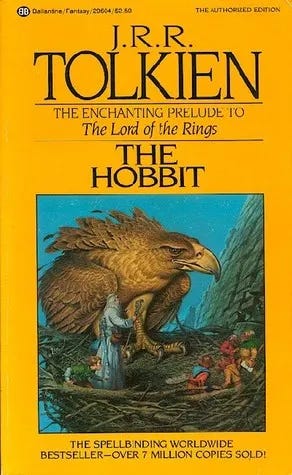
Like all of the greatest children’s books, The Hobbit is not only for kids, though. I enjoyed it many times throughout my teens and twenties, and again when I read it to my own son some 15 or so years ago. I’ve enjoyed it just as much on this re-read.
A great book for kids doesn’t have to be Captain Underpants or Diary of a Wimpy Kid. Don’t get me wrong, I don’t find anything wrong with either of those, especially if they get children to read. But they’re not something an adult is most likely going to pick up and enjoy. A great children’s book can simply be a great book, period. That’s the category where The Hobbit fits.
Having recently revisited the classic Rankin-Bass animated movie, my memory was refreshed on the tale in broad strokes, but I was still surprised at some of the details that I didn’t remember — even though I’ve read the book in the neighborhood of 20 times.
More surprising still was my discovery of just how much influence The Hobbit had on my first two Gold and Fire books. (Note that I am in absolutely NO way comparing my books to Tolkien.) I mean, I knew it was there. The cave with the secret entrance at the back that led to a tunnel and a great treasure in Dreams. The “lonely” mountain that towered above the rest that was home to a dragon in Sons. Those were both intentional choices meant as an homage to Tolkien’s classic and the impact that it had on my life.
But there were other things that surprised me. Some of Bilbo’s thought processes seemed fairly familiar, and the breathless way that Tolkien throws his hero into one peril after another on the road of his quest was certainly echoed by Aron’s journey in Sons. I suppose The Hobbit was fairly fresh in my memory when I wrote the first novel-length draft of Dreams as I’d recently read it to my son, but when I wrote Sons, it had been at least 15 years since I’d cracked the cover.
So, was it just an unconscious influence from a book that, quite literally, changed my life or was it something else? Was it maybe that The Hobbit has pretty much influenced all fantasy that followed in such a way that, if I were looking for it, I would find the same sorts of parallels in most of the tales I’ve read over the years and nearly everything that’s influenced me? Probably a little bit of both.
The Hobbit strikes a balance, though, that few fantasies achieve. It’s both quaint and epic at the same time. It’s a charming and cozy comfort read, yet filled with trolls, goblin battles, giant spiders, werebears, a marauding dragon, and a lesson on the perils of greed.
As with most internet arguments, I find the one about whether or not The Hobbit is for kids or adults to be a silly one. The answer is, of course, yes. There’s really no need to add a descriptor about age range when you describe it. Simply call The Hobbit a magnificent book.